App Review: i-Sokki Japanese Vocabulary for JLPT

When preparing for the JLPT, one of the biggest problems learners face is the large amount of Japanese vocabulary. If you live in Japan or at least get enough Japanese input then the listening section of the exam is easy enough. You can cram on the grammar and learning kanji intelligently will greatly ease your pain. With vocabulary though, there’s no getting around it. You have to expose yourself to the language and put in enough time to learn it.

As I mentioned here, I am planning to take N1 this summer. I have always been lazy about the JLPT but I figure that the certification might come in handy someday. One of my friends mentioned that he was using a free app called i-Sokki (limited version) for drilling vocabulary for the exam. I downloaded it last week and I really like it so far.

I-Sokki is easy on the eye. It’s a nicely designed app. It comes with the vocabulary for N5 unlocked already. You have to pay to get access to the other levels, but at $1.99 per JLPT level or $4.99 for all levels, the price is reasonable. I’m mainly working on N1 words but, just in case, I’m brushing up on the N2 vocab too so I bought the whole set.

There are three different quiz modes for testing your vocab knowledge. All of them are multiple choice.

Japanese Mode tests from Japanese to English so it is probably the easiest test as you can intelligently guess a lot of words without truly knowing them.

Kanji mode tests from Japanese to the kana reading. I use this one a lot. One small gripe I have with the Kanji mode is that you can only see the English meaning after you have finished the review session. I would like the option to quickly remind myself of the meaning but anyway, it’s a minor flaw.

Finally, there is Reverse Mode which, as you might expect, tests you going from English to Japanese. I rarely use this one.

The app tests you based on your “familiarity” with the various vocabulary. I think they do a solid job. I’m using I-Sokki during the little moments when I’m sitting on the train or waiting for a friend. I look up new words in my Wisdom Dictionary (reviewed here) and read through the example sentences to help the meaning take root in my mind. This strategy is working well so far, although I passively know most of the vocabulary already. Depending on your Japanese level, your results may differ.

I-Sokki is not a perfect app. Sometimes I find the same vocabulary repeatedly coming up on the tests, so I’m confused how the algorithm works. Also, there is obviously no way that the app can know your starting knowledge so you have to review a bunch of known words in the beginning. The biggest downside for me though, is that the other words in the test are usually very different from the correct answer. The kanji mode, for example, will often show three ridiculous meanings that are obviously incorrect with one reasonable looking answer. This makes things too easy as you can guess the answer without even knowing it. In the JLPT, similar looking answers are displayed to confuse you. I wish this app did the same. One way to get around this is to mentally test yourself before looking at the four choices being displayed.

With the few caveats I mentioned, i-Sokki is a handy tool for studying for the exam. I recommend you pick up the free version and see how you go.

We like what we see, but we’re still trying to figure out this Google Plus thing. Follow us on there to stay in the loop. We also also do Facebook and Twitter.

Share

Japanese names dictionary is back!

Due to popular demand, we have restored the names dictionary for the latest Japanese Firefox update. Sorry for the long wait. The add-on is currently awaiting approval by Mozilla so it should be released soon. Edit: The update has now been approved. Enjoy!

Cheers

The Perapera Team

We are planning further updates and Japanese-related posts in the near future. To keep up with the latest news and info, follow us on Google+ or like us on Facebook!

Share

App Review: The Wisdom 2 English-Japanese Dictionary

I recently bought the Wisdom 2 iOS app because I had heard good things about the previous version and found a great deal for it on the iTunes store (Apparently it has been reduced to $11.99 from around $30 until the end of this month). I have been using the dictionary for the last couple of weeks and have to say that it has already taken a central role in my Japanese studies and my everyday life too.

Often, I find myself talking to friends or colleagues and have a word on the tip of my tongue that I just can’t remember. Other times, I wonder how to say a certain phrase in Japanese that I have never considered before or want to explain a concept to someone but my explanation is faltering from a lack of active vocabulary. Normally, if this was a language exchange or some other event where I would expect to practise Japanese, I would bring my electronic dictionary but it’s not exactly practical (or sociable!) to whip your Seiko out in the middle of a crowded izakaya. iPhone apps are much quicker and more convenient in those situations. That’s where Wisdom 2 comes in handy.

How I am using it

I haven’t really used Wisdom 2 for long study sessions although I’m sure it could be used that way. I think of it more as an on-the-go kind of dictionary that helps me look up words speedily when I don’t have a PC or dictionary at hand.

I read through the example sentences a lot and also like the fact that you can directly look up any unknown words from the example sentences by simply holding down the word. As this is a dictionary in the classic sense, there aren’t many study tools or review options for learning the new vocabulary. There is a fairly simple bookmarking function though (that incidentally backs up to iCloud) that allows you to save new words for later.

The dictionary

Wisdom 2 is based on the “Wisdom English-Japanese Dictionary 3rd edition” and contains more than 100,000 entries, which should be enough to keep you busy. Although it comes recommended for people like us who study Japanese, Wisdom 2 has evidently been made with Japanese learners of English in mind. If you are just starting out in your Japanese studies, you should be aware that the app’s interface is only available in Japanese so you should be at least an intermediate Japanese reading level before considering this.

What’s New in the latest version (Version 1.0.1)

According to the developers, here is of what’s new for the latest release (rough translation):

- Character size settings can now be modified more precisely.
- A clipboard search function has been added. By turning “Clipboard Search” on in the settings menu, you can now search text copied from other apps when you start up Wisdom 2.
- Problem fixed for display of invalid characters in the Japanese-English dictionary contents.
- Problem solved for iPhone/iPod touch when text selected for an extended amount of time remains displayed even after the selection has been cancelled.
- The viewing history is now also updated when a word is chosen from within the viewing history itself.
- The functionality for clearing previous searches has been improved.

All in all, Wisdom 2 is a valuable tool for learning Japanese. If you are serious about learning Japanese, then this app is a good choice. Check it out and tell us what you think!

Cheers

The Perapera Team

P.S Yes, an update is coming for the Japanese Firefox plugin and due to feedback from a fairly loud minority of users, the names dictionary will return. Watch this space!

We’re still trying to figure it out, but Perapera Language Tools is now on Google Plus. Follow us over there or on Facebook to receive updates on our latest linguistic endeavors.

Share

The Kindle Paperwhite: A godsend for Japanese learners (if you’re in Japan)

Happy New Year everyone! I don’t know about you, but the New Year has got me motivated to get back to studying languages and reading more Japanese. I also plan to take the N1 this summer. I will touch on that in future posts. Another of my long-term goals is to become more literate in Japanese and to read books that Japanese people read.

I like reading Japanese news and blogs like Itai News on my PC and iPad but I have always wanted to read more Japanese content offline. It’s more relaxing with a book and looking at a screen all day makes my eyes sore. However, I hate looking up kanji and new vocabulary manually. It takes a lot of time and distracts me from the book I am reading. This and a lack of space in my tiny Japanese apartment has meant that, over the years, I haven’t bought that many books in Japanese. Up until now, there haven’t been many Japanese e-books available either. Well, I have finally found my solution.

Amazon’s answer to e-books in Japan

As you may well know, Amazon released the Kindle Paperwhite in Japan at the end of last year. I preordered mine and have been pleased with it so far. It’s a beautiful product and much lighter and easier to use than the previous models (My Kindle 2 looks like it came from a different century!). You get a Japanese-Japanese dictionary with it as standard which really lightens the load of looking up new words. Granted, the lookup function is not quite as good as Perapera (a tricky feat to be fair :) ) but it’s much better than trying to work out the readings and manually inputting words into an electronic dictionary.

One big downside at the moment is the Kindle Store in Japan. Amazon have apparently struggled winning over Japanese publishers who are hesitant to embrace e-books and see their cosy business model crumble. The lack of publishers definitely shows. Compared to the Amazon.com Kindle store, the selection of books is woefully lacking. Hopefully this improves in the future (knowing Amazon it probably will!). That said, according to Amazon there are already more than 10,000 free e-books available which should keep Japanese learners busy for a while.

Also, as far as I am aware, the Kindle Store for Japan is only available for people in Japan with a Japanese IP. I haven’t been able to find much information on this, but it would be good if someone could provide some more information on this. Anyone?

What am I reading?

So far, I have been reading the following free books:


Kokoro

I admit that I have not read a lot of Japanese fiction. I’m usually more of a non-fiction guy but figured I’d give this one a short as one of my colleagues highly recommended it.


Botchan

Another famous novel by Natsume Soseki that most Japanese seem to have read.


The Japanese Constitution

I downloaded this because I fancied reading the post-war original in Japanese but unsurprisingly, it is boring as hell.

I have also bought one paid book, Michi Wo Hiraku (The Path) which is a Japanese business classic that I have always wanted to read. The author, Konosuke Matsushita, founded Panasonic so I guess he knew what he was talking about.

So all in all, there are some negatives but I can still recommend the Kindle Paperwhite as a great tool for intermediate and advanced learners of Japanese. As I progress I will update you on what I am reading. I will also share in another post how I am using my Kindle to learn and review new vocabulary.

Share

Learn Japanese kanji the smart way

The first book I ever bought for learning Japanese was a kanji book. This was long before I had visited Japan or knew any Japanese. Little did I know that my long battle with learning the kanji had just begun. To the beginner, there is something intimidating about the prospect of learning these characters. To many, memorizing 2000 seemingly random squiggles to reach functional literacy sounds like an impossible undertaking.

Heisig’s Remembering the Kanji proved to be a great start for me for learning the kanji. The idea of making stories for each character is a genius way to break down otherwise complicated compounds into memorable entities.

But there was one big hole in Heisig’s book. After 500 or so characters he drops the bomb when he leaves you to make your own stories alone. In my case,  I found it difficult to make my own kanji stories. Perhaps I was lacking creativity, I thought as I continued to struggle. Unfulfilled New Year’s Resolutions came and went and I cursed Heisig for not finishing his book. Other long-term Japan expats have told me they had similarly frustrating experiences with Heisig’s book.

Happily though, I found a great free online resource, Reviewing the Kanji. The Reviewing the Kanji site has kanji stories for Heisig’s book made by and voted upon by users. You can add the characters as you work your way through the book and schedule reviews. It’s a nicely designed site and easy to use. This is a great addition to the book. Suddenly, you have countless stories for each character at your disposal.

The combination of the site and Heisig’s book allowed me to vastly improve my knowledge of the kanji and their radicals. The readings had to be learned separately by wide reading (hint, hint PeraPera :) ) but I’m of the opinion that being familiar with the characters and their radicals is useful and these resources certainly helped me along the way.

Hope those starting out or wanting to refresh their kanji knowledge found this useful. So how did you learn the kanji? Any advice for our readers? We’d love to see other advice people have!

Share

More good books for learning Japanese

We got some good feedback for our best 10 books for Japanese post so we thought we would add some more to the list of worthy study aids for Japanese. The books we present here are somewhat more advanced than the previous post. If you are just starting out, we recommend you check out the books in the top 10 post before getting these.

Read Real Japanese

This is a great book for making the tricky jump from intermediate to advanced Japanese. Of course, you can read “real” Japanese anytime nowadays online but it’s sometimes nice to have explanations for unknown expressions and writing styles you come across. The book contains eight varying and interesting essays by famous Japanese authors such as Haruki Murakami, Seiko Ito and Banana Yoshimoto. I enjoyed studying with this book except for the author’s inexplicable usage of romaji in the vocabulary explanations. Why would an advanced learner still be using romaji? Anyway, it is an interesting read and you should be able to find it used for cheap on Amazon.

Read Real Japanese Essays: Contemporary Writings by Popular Authors 1 free CD included

The follow-up to the original is much improved with an audio CD included and the romaji scrapped! It gets difficult in some places and new kanji readings are only given once so it’s definitely for intermediate learners and up.

Read Real Japanese Fiction

Similar to the last two books but for fiction. I don’t own this one but it has some good reviews so it is probably safe to assume it’s of the same quality as the others in the series.

Nihongo Through Newspaper Articles

Another pretty solid offering from the Japan Times for building up your Japanese vocabulary. Each lesson presents a new article with vocab and exercises. There’s also two audio CDs included. A lesson a day will quickly improve your reading comprehension.

Nyuzu de fuyasu jyokyu he no goi/hyougen (Amazon Japan)

Another news-based intermediate book I found useful. The articles tend to be a bit longer than the Japan Times book. Audio CD included. One minor annoyance is the furigana on every single word in the articles. I guess it is better than no furigana…I bought this book a few years ago in Japan and it appears to be relatively unavailable abroad.

Nihongo nouryoku shiken N1 ni deru jyuyou tangoshuu (Amazon Japan)

Another book you might have trouble finding outside of Japan. It is supposed to be used for studying for the top level (N1) of the JLPT but it would be useful for most intermediate to advanced learners. If you think your Japanese is getting there, prepare for your ego to be shattered. Each page has deceptively similar looking words and expressions that will really test your knowledge. We follow a general rule that any books by the excellent publisher, ALC, are generally a good bet. This is no exception. It is a great little book which will take you a long time to master!

Share

Perapera Japanese 9.0 Finished!

Sorry it’s taken this long, but the updated Perapera popup dictionary plugin for Japanese is now finished and has been approved by Mozilla.

Bugs fixed, broken features in latest Firefox unbroken, and the same popup themes the Chinese Plugin users have enjoyed have now been added along with the ability to customize the colors. Enjoy!

Look forward to everyone’s feedback. More good things to come soon!

Share

Kanji In Context Anki File

Hello all,

Recently I got back into the kanji study so I’m reviewing them all (again) using the famous Kanji In Context book. So I made an Anki file to study from so I figured I would release it to all you guys who might also find it useful. I added it to my “Files” box on the left here so you can download it from there.

I tagged each entry with both the chapter (C1-C147) and section (S1-6) that it came from for easy sorting. I also tagged every entry with ‘mada’ and suspended all the entries with that tag. So the idea is to go in and remove the ‘mada’ tag from the ones you have done and as you complete the chapters to enable them.

To do this go to Edit->Edit all, then on the top right you can click a drop down on which tags to show, select either the chapter or section of the cards you want to enable, then select all the entries that appear (click one then ctrl+a). Now goto Actions->Delete tag, and type in ‘mada’  and click ‘ok’. Now the tag is removed and those cards will be enabled.

Enjoy!

Download

ps. If anyone doesnt know what Anki is, its a great flashcard program with tons of features. Check it out: http://ichi2.net/anki/

Share

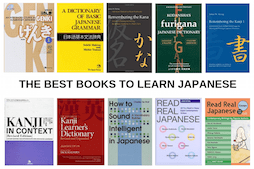
Our 10 best books for learning Japanese

In the 6 years of Japanese study we have bought many many books always looking for the one to rule them all. It became almost a weekly habit and an obsession, so after all that here is what we think are the best ones we would recommend to others starting the journey.

A Dictionary of Basic Japanese Grammar

There’s a reason why this book is known as the “Yellow Book” or “The Bible” among Japan expats. It is probably the best Japanese learning resource I have ever come across. Clearly and thoroughly written with great example sentences. If you are at a more advanced level, check out the “Blue” and “Red” books by the same authors.

Kodansha’s Furigana Japanese Dictionary

Best Japanese-English dictionary out there. Lots of example sentences.

Pimsleur Japanese

Not strictly a book, but it’s a great audio course for starting out in Japanese. Gets a bit too corporate for my liking towards the end of the 3rd series, but you will remember and be able to use what you learn with Pimsleur.

Remembering the Kanji, Volume 1: A Complete Course on How Not to Forget the Meaning and Writing of Japanese Characters

An invaluable book for mastering the kanji. Required reading for all serious learners of Japanese. I haven’t used books 2 or 3 much but some people seem to like those too.

Kanji Study Cards

Kanji study cards that accompany James Heisig’s Remembering the Kanji (above). It is definitely nice having all 2048 kanji with their readings in one set and it saves you the effort of making the cards/notes yourself. If you’re lazy like me it’s a no-brainer!

Kanji in Context

Wow..I guess I have a lot of kanji-related books! This book allows you to build a strong vocabulary after using Heisig’s book. Might be hard to get outside Japan, but I also recommend the accompanying workbook.

The Kodansha Kanji Learner’s Dictionary

Great kanji reference. Used this so much it brings back good memories of my first stint in Japan.

Remembering the Kana: A Guide to Reading and Writing the Japanese Syllabaries in 3 Hours Each

In this book James Heisig applies his mnemonics method to learning to read and write the Hiragana and Katakana. I found it helpful when I was starting out.

How to Sound Intelligent in Japanese: A Vocabulary Builder

This is a very useful Vocabulary Builder but more importantly, just owning it makes me feel smarter :)

Making Out in Japanese
Had a lot of fun with this book! Not a serious one but definitely had a lot of laughs with it.

So there you have it. There are probably more (I have spent $$$s on Japanese books over the years) but those are the books that stood out for me. Enjoy!

Update: We have since posted up some more helpful books for studying Japanese. Check them out here.

Share

FF 5.0 Update

Man FF is annoying, they do a point release without adding any new features but still decide to have it break all the extensions. Anyways, the dictionary files are updated, but since mozilla is taking forever to allow the dictionary files to be added to their mozilla extension site allowing automatic update, you need to manually reinstall the dictionary files below to have Perapera work on FF5.0. The plugin itself should not need any kind of reinstall.

Japanese-English Dictionary

Chinese-English Dictionary

Chinese-German Dictionary

Share